Revised Hart-Scott-Rodino Act Thresholds and Filing Fees Announced
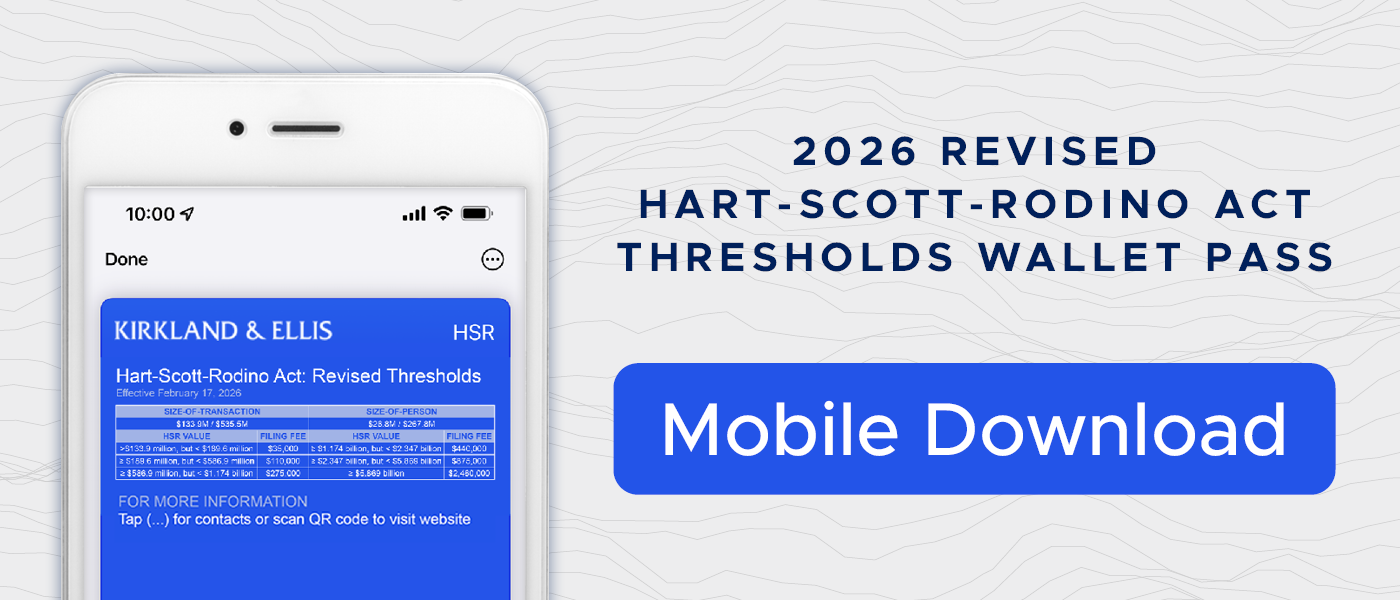
The Federal Trade Commission (“FTC”) recently published revisions to the Hart-Scott-Rodino (“HSR”) Act reportability thresholds and new HSR filing fees and fee thresholds.
The new HSR Act filing reportability thresholds are effective for transactions closing on or after February 17, 2026 (the “effective date”). The new filing fees and fee thresholds will apply to any filings submitted on or after the effective date. Filings made prior to the effective date are not impacted by the changes to either set of thresholds. The HSR Act requires annual adjustment of the thresholds based on the change in the U.S. gross national product. All thresholds will increase from the prior year.
Updated HSR Reportability Thresholds
Under the updated reportability thresholds, and subject to certain exemptions, HSR forms must be filed when, as a result of an acquisition, the buyer will hold assets, voting securities, and/or non-corporate interests valued in excess of $133.9 million and the transaction involves parties with annual net sales or total assets valued at $26.8 million or more and $267.8 million or more, respectively. If the value of the assets, voting securities, and/or non-corporate interests to be held after the acquisition will exceed $535.5 million, then — again, subject to certain exemptions — HSR filings must be submitted regardless of the size of the parties.
The chart below summarizes the original thresholds set forth in the HSR Act and regulations, as well as last year’s thresholds and the new thresholds.
| Original Thresholds | 2025 Thresholds | New 2026 Thresholds | |
| Size-of-Transaction |
$50 million $200 million |
$126.4 million |
$133.9 million $535.5 million |
| Size-of-Person (for transactions valued below $200 million (as adjusted)) | $10 million $100 million |
$25.3 million |
$26.8 million $267.8 million |
Please note that there is no change in dollar values with respect to either (1) the exemption for acquisitions of certain reserves of oil, natural gas, shale or tar sands, or rights to reserves of oil, natural gas, shale or tar sands and associated exploration or production assets valued at less than $500 million, or (2) the exemption for acquisitions of certain reserves of coal, or rights to reserves of coal and associated exploration or production assets valued at less than $200 million.
New Filing Fee Tiers
Filing fees and fee thresholds will increase across the board. For filings made on or after February 17, 2026, the following new filing fees and fee thresholds will apply:
| Transaction Value | Filing Fee |
| Greater than $133.9 million but less than $189.6 million | $35,000 |
| Greater than or equal to $189.6 million but less than $586.9 million | $110,000 |
| Greater than or equal to $586.9 million but less than $1.174 billion | $275,000 |
| Greater than or equal to $1.174 billion but less than $2.347 billion | $440,000 |
| Greater than or equal to $2.347 billion but less than $5.869 billion | $875,000 |
| $5.869 billion or more | $2,460,000 |
Both the fee tiers and the filing fees will be adjusted annually based on the change in gross national product and changes to the consumer price index. Any adjustments to the filing fees will be rounded to the nearest $5,000.
Determining whether an HSR filing is required and what exemptions may apply is complicated, with substantial penalties for non-compliance: the current maximum civil penalty for violations is $53,088 per day. This daily fine will also adjust for 2026, but as of January 20, 2026, the increased amount has not yet been announced.Application of the HSR thresholds to a transaction involves detailed knowledge of the HSR Act and its implementing regulations. If you have any questions regarding the HSR Act, the new thresholds or whether a transaction is subject to HSR reporting please contact the authors below or your regular Kirkland contact.